
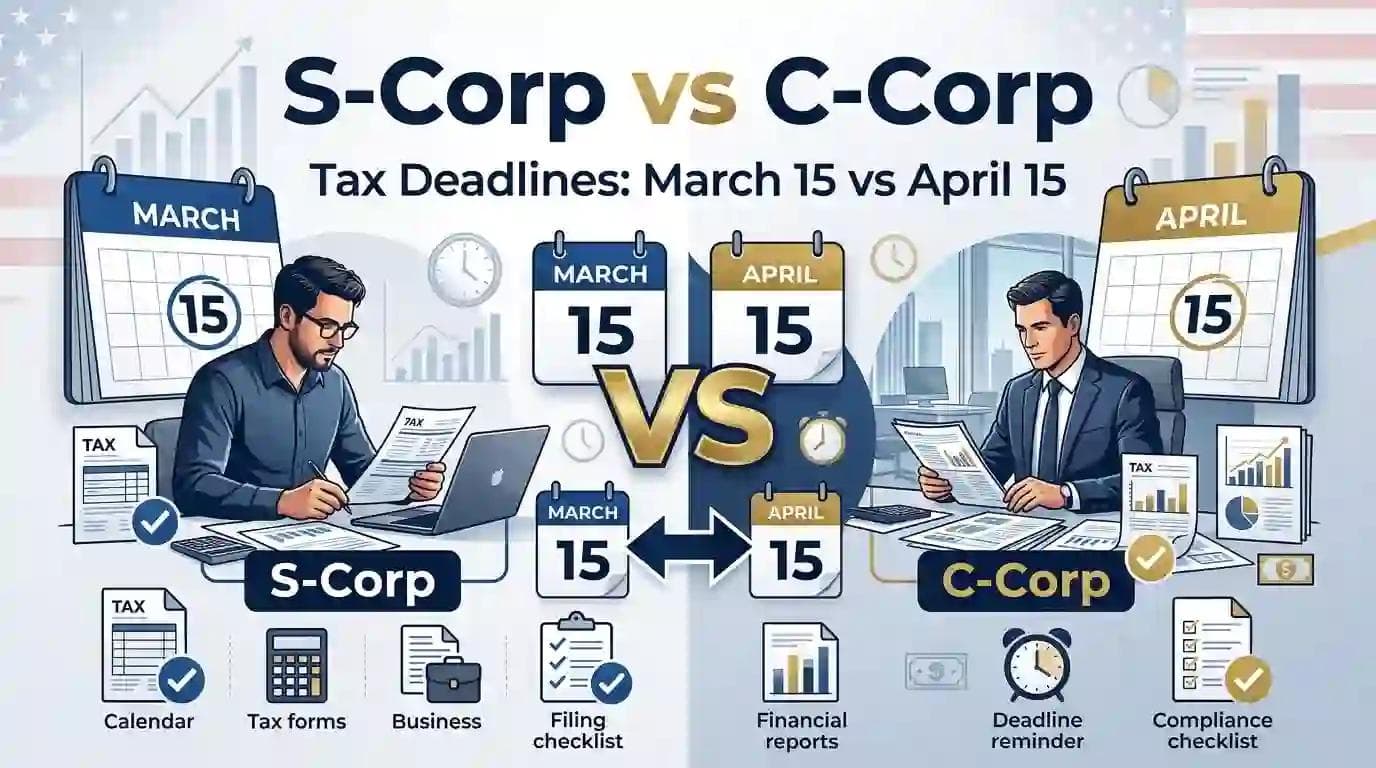
If you've ever wondered why your accountant is calm in early April but stressed out a full month earlier in mid-March, the answer comes down to one thing: entity type. S-Corporations and C-Corporations don't just get taxed differently; they file on completely different dates, and mixing up the two is one of the most common (and expensive) mistakes small business owners make.
This guide breaks down exactly why S-Corps file by March 15 while C-Corps file by April 15, what forms each one uses, what happens if you miss either deadline, and how extensions work for both. If you're unsure which structure you're even operating under, or whether your current setup still makes sense, Brandora's Taxation & Accounting services can review your entity structure and filing history to make sure nothing's been missed.
S-Corp vs C-Corp: Quick Comparison
Factor | S-Corporation | C-Corporation
Tax deadline | March 15 | April 15
Tax form | Form 1120-S | Form 1120
Taxation structure | Pass-through (no entity-level tax) | Double taxation (entity + shareholder level)
Extension form | Form 7004
Extension length | 6 months (to September 15)| 6 months (to October 15)
Late filing penalty basis | Per shareholder, per month | Percentage of unpaid tax, per month
Why Do S-Corporations File by March 15?
S-Corporations are pass-through entities. This means the business itself generally doesn't pay federal income tax; instead, profits and losses pass through to the shareholders, who report that income on their own personal tax returns via a Schedule K-1.
The March 15 deadline exists specifically to give shareholders enough time to receive their K-1 forms before their own personal tax deadline of April 15. If S-Corps filed on the same day as individuals, shareholders wouldn't have their K-1 information in hand until it was already time to file their own returns, creating a scramble every single year. The earlier corporate deadline exists purely to keep that handoff smooth.
S-Corps file Form 1120-S, the U.S. Income Tax Return for an S Corporation, which reports the company's income, deductions, and each shareholder's allocated share of profit or loss.
Why Do C-Corporations File by April 15?
C-Corporations are taxed differently. The corporation itself pays corporate income tax on its profits, and then shareholders are taxed again on any dividends they receive; this is what's commonly referred to as double taxation. Because there's no K-1 pass-through requirement forcing an earlier deadline, C-Corps file on the standard April 15 deadline, the same date as individual taxpayers (for calendar-year corporations).
C-Corps file Form 1120, the U.S. Corporation Income Tax Return, which reports the corporation's income, deductions, and tax liability at the entity level.
What If Your Business Uses a Fiscal Year Instead of a Calendar Year?
Both deadlines above assume a standard calendar-year business (January 1 to December 31). If your S-Corp or C-Corp operates on a fiscal year instead, the deadline shifts accordingly:
S-Corps: due on the 15th day of the third month after the fiscal year ends
C-Corps: due on the 15th day of the fourth month after the fiscal year ends (with one notable exception for C-Corps with a June 30 fiscal year end, which follow a different schedule entirely)
Most small businesses operate on a calendar year for simplicity, but if yours doesn't, it's worth confirming your exact deadline rather than assuming March 15 or April 15 applies.
What Happens If an S-Corp Misses the March 15 Deadline?
Missing the S-Corp deadline triggers a penalty calculated differently than most other business penalties; it's charged per shareholder, per month (or partial month) the return is late, up to a maximum of 12 months. This means the penalty scales directly with how many shareholders your S-Corp has; a two-shareholder S-Corp filing three months late pays roughly double what a one-shareholder S-Corp would pay for the same lateness.
This penalty structure catches people off guard because it's not based on unpaid tax, since S-Corps typically don't owe entity-level tax; the penalty exists purely to enforce timely K-1 delivery to shareholders.
What Happens If a C-Corp Misses the April 15 Deadline?
C-Corp late filing penalties work more like traditional business tax penalties, calculated as a percentage of unpaid tax for each month or partial month the return is late, up to a cap. On top of the late filing penalty, the IRS also charges interest on any unpaid balance from the original due date until it's paid in full.
Because C-Corps do owe entity-level tax, missing this deadline while also having a balance due is more directly costly than the S-Corp equivalent; the penalty grows in direct proportion to what's owed.
Can S-Corps and C-Corps Get a Tax Extension?
Yes, both entity types can request a six-month extension by filing Form 7004 before their original deadline.
For S-Corps: filing Form 7004 by March 15 extends the deadline to September 15
For C-Corps: filing Form 7004 by April 15 extends the deadline to October 15
Here's the detail that trips people up for both entity types, exactly like it does for individuals: an extension to file is not an extension to pay. If a C-Corp owes tax, that payment is still due on the original April 15 deadline, regardless of the extension. Interest and the failure-to-pay penalty continue accruing on any unpaid balance even after a valid extension is filed.
Side-by-Side: Extension Details
Detail | S-Corp | C-Corp
Extension form | Form 7004 | Form 7004
Original deadline | March 15 | April 15
Extended deadline | September 15 | October 15
Payment still due on original date? | N/A (pass-through, typically no entity-level tax) | Yes
Why This Distinction Actually Matters for Business Owners
Beyond just knowing which box to circle on a calendar, understanding this difference affects real decisions:
If you're deciding between S-Corp and C-Corp status for a new business, the filing deadline itself is a minor factor, but the underlying taxation structure it reflects (pass-through vs double taxation) is a major one worth understanding fully before you file Form 2553 to elect S-Corp status.
If you're a shareholder in an S-Corp, missing the March 15 deadline doesn't just cost the company money; it delays your own K-1, which can put your personal April 15 filing at risk too, creating a domino effect across everyone involved.
If your business is currently a C-Corp and you're wondering whether switching to S-Corp status makes sense, the deadline shift is one of many practical changes worth factoring in alongside the tax rate differences. If this decision applies to your business more broadly, our comparison of sole proprietorship vs LLC tax differences is a useful starting point for understanding how entity choice shapes your tax obligations more generally.
What Happens If You're Filing for the First Time?
New business owners frequently assume all business tax returns are due April 15, since that's the date most people associate with "tax season." If you've just formed an S-Corp, or elected S-Corp status partway through the year, mark March 15 clearly; this is the deadline that catches first-time filers most often.
If you're still deciding how to structure a new business and haven't filed formation paperwork yet, it's worth getting the entity choice right from the outset rather than restructuring later. Our guide on best states for LLC tax savings covers related considerations if you're still weighing your options before committing to a structure.
A Real-World Example
Consider a small consulting business with three shareholders operating as an S-Corp. The company missed the March 15 deadline and filed 46 days late, counting as two late months under IRS rules. Because the per-shareholder penalty applies to each of the three shareholders for each of those two months, the total penalty was six times the base monthly rate, a cost driven almost entirely by shareholder count, not by any unpaid tax.
Now compare that to a C-Corp with $50,000 in unpaid tax that also filed two months late. Its penalty was calculated as a percentage of that $50,000 balance for each of the two months, plus accruing interest, an entirely different calculation, but one that can end up costing considerably more in dollar terms depending on the balance owed.
The lesson from both examples is the same: neither entity type is "safer" to file late. The penalty structures are just built differently.
Why Choose Brandora Services
Whether your business operates as an S-Corp or a C-Corp, keeping track of two entirely different deadlines, forms, and penalty structures is easy to get wrong, especially if you've recently changed entity type or you're managing multiple shareholders. Brandora Services' ACCA and CA-certified tax professionals handle S-Corp and C-Corp filings, extension requests, and entity structuring, so you're never caught off guard by which deadline applies to you.
According to the official IRS guidance on business structures, the IRS outlines these entity distinctions directly, worth a look if you want the source information straight from the agency itself.
How to Stay Ahead of Both Deadlines
A few practical habits keep this from becoming a yearly scramble:
Confirm your entity type and corresponding deadline at the start of each tax year; don't assume it's the same as last year if anything changed
Set calendar reminders at least 30 days before March 15 (for S-Corps) or April 15 (for C-Corps) to gather documents
If you're an S-Corp shareholder, follow up early if your K-1 hasn't arrived with enough time before your personal deadline
File Form 7004 well before the original deadline if you know you'll need the extra time; don't wait until the last day
Keep entity-level records organized year-round rather than reconstructing them under deadline pressure
Frequently Asked Questions
Why is the S-Corp tax deadline March 15? The earlier deadline gives shareholders time to receive their Schedule K-1 before their own personal tax deadline of April 15, since S-Corp income passes through to shareholders' individual returns.
Why is the C-Corp tax deadline April 15? C-Corps are taxed at the entity level rather than passing income through to shareholders immediately, so there's no K-1 timing requirement forcing an earlier date, and they follow the standard April 15 deadline for calendar-year filers.
What happens if an S-Corp misses the March 15 deadline? The IRS charges a penalty per shareholder, per month the return is late, up to 12 months, meaning the total cost scales with how many shareholders the S-Corp has.
What happens if a C-Corp misses the April 15 deadline? C-Corps face a penalty based on a percentage of unpaid tax for each month the return is late, plus interest on any outstanding balance from the original due date.
Can S-Corps and C-Corps get a tax extension? Yes, both can file Form 7004 for a six-month extension. S-Corps move to September 15, and C-Corps move to October 15. Note that this extends the filing deadline only, not the payment deadline for C-Corps.
Is C-Corp income taxed twice? Yes. The corporation pays tax on its profits at the entity level, and then shareholders pay tax again on any dividends they receive from those after-tax profits; this double taxation is a defining feature of C-Corp status.
Final Thoughts
The March 15 versus April 15 split between S-Corps and C-Corps isn't arbitrary; it reflects a fundamental difference in how each entity type is taxed. S-Corps file early because their income flows directly to shareholders who need time to prepare their own returns. C-Corps file on the standard date because the tax obligation stays with the entity itself.
Getting this date wrong, even by accident, triggers penalties that are calculated completely differently depending on which entity you're running. Knowing your entity type, marking the correct deadline, and filing Form 7004 early if you need more time are the three habits that keep this from becoming a costly surprise.
Not sure which entity type your business falls under, or want to make sure your filing deadlines and extensions are handled correctly this year? Brandora Services' certified tax team manages S-Corp and C-Corp filings, K-1 preparation, and extension requests, so nothing slips through the cracks. Book a free consultation to get your filings sorted well before either deadline hitss.