
There is no state where forming an LLC automatically makes your capital gains, dividends, or investment income tax-free. States like Wyoming, Nevada, Texas, and South Dakota have no state income tax, but if you personally live in California, New York, or another income-tax state, you'll almost always still owe your home state's tax on that income — regardless of where the LLC is formed. The only time the state of formation genuinely changes your tax bill is when you actually live, work, or are legally domiciled in that state. This single misunderstanding is the reason most people research this topic in the first place, so let's clear it up before anything else.
This article is for general educational purposes only and isn't personalized tax or legal advice. State tax rules change frequently and depend on your specific residency, income type, and business structure — consult a licensed CPA or tax attorney before making formation decisions.
The "Form in Wyoming and Skip My Taxes" Myth — Debunked First
This is the single most common misconception in this space, and it deserves to be addressed immediately rather than buried at the bottom of the article.
An LLC is a pass-through entity. That means the LLC itself usually doesn't pay federal income tax — profit "passes through" to the owner's personal tax return. The same logic applies at the state level: most states tax an LLC's income based on where the owner lives (or is domiciled), not simply where the LLC's paperwork was filed.
So if you live in California and form an LLC in Wyoming to hold stocks or rental property, California doesn't just let that income disappear. In most cases, you'll still owe California state tax on your share of that income, and you may also owe Wyoming registration fees and possibly have to register your Wyoming LLC as a "foreign LLC" doing business in California — meaning extra paperwork and cost, with no tax savings to show for it.
This is sometimes called the home state tax trap, and it catches a lot of first-time investors who read a headline like "Wyoming has no state income tax" and assume that's the end of the story.
When does the state of formation actually matter for taxes? Mainly when:
- You genuinely live in or relocate your legal domicile to a no-income-tax state, or
- The LLC's income has a real, provable nexus to that state (for example, real estate physically located there), or
- You're comparing state-level LLC fees and franchise taxes (which do vary meaningfully by state) rather than your personal income tax rate
With that out of the way, here's what actually does vary by state — and where it's worth paying attention.
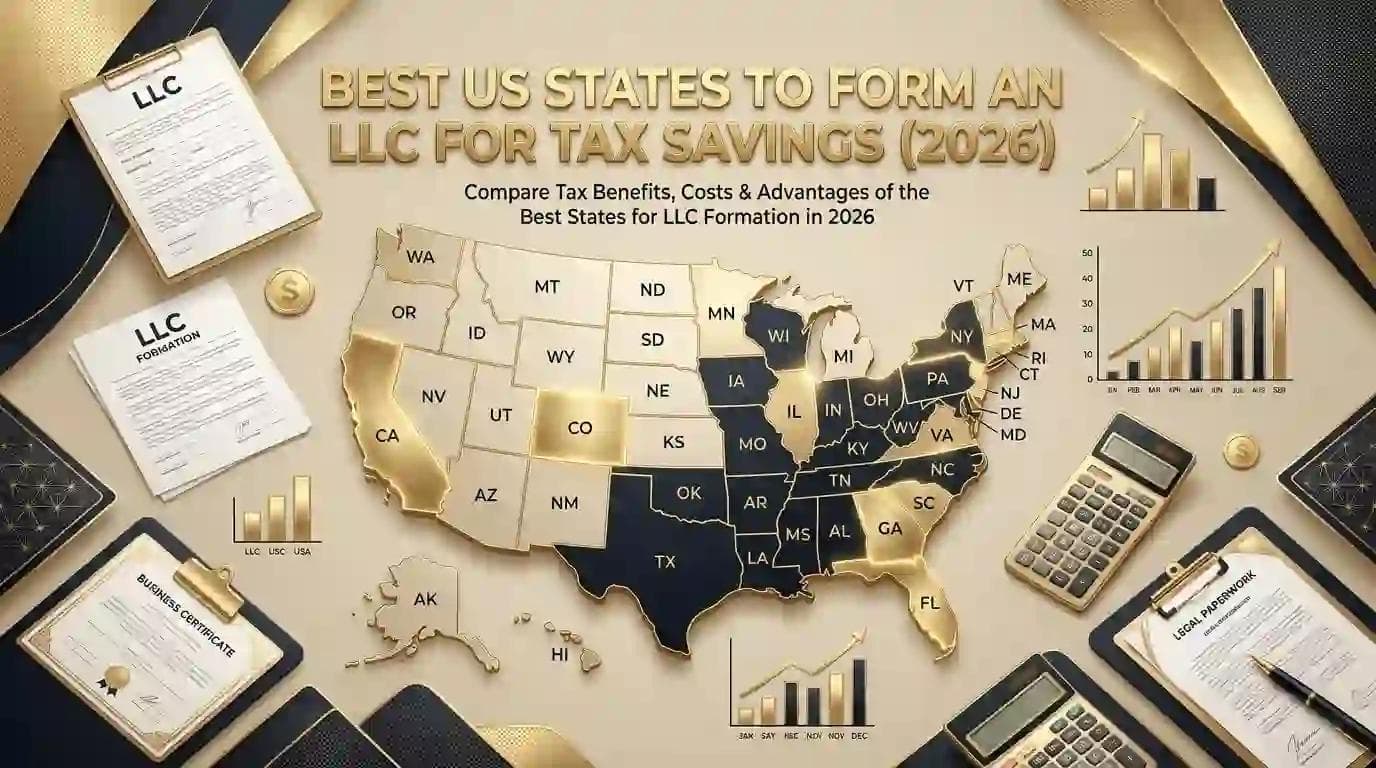
States With No State Income Tax (Where It Actually Helps)
If you're a genuine resident of one of these states, or your investment income has a real nexus there, forming your LLC in the same state can align nicely with these tax advantages:
Wyoming
State Income Tax: None
LLC Filing Fee: ~$100
Annual Report / Franchise Tax: ~$60/year (or based on assets)
Notable For: Privacy, low fees, asset protection
Nevada
State Income Tax: None
LLC Filing Fee: ~$425
Annual Report / Franchise Tax: ~$350/year
Notable For: Strong asset protection, no information-sharing agreement with IRS
Texas
State Income Tax: None (but has franchise tax)
LLC Filing Fee: ~$300
Annual Report / Franchise Tax: Franchise tax above a revenue threshold
Notable For: Large economy, no personal income tax
South Dakota
State Income Tax: None
LLC Filing Fee: ~$150
Annual Report / Franchise Tax: ~$50/year
Notable For: Simple structure, trust-friendly laws
Florida
State Income Tax: None
LLC Filing Fee: ~$125
Annual Report / Franchise Tax: ~$138.75/year
Notable For: Popular for real estate holding LLCs
For residents of these states, this is where "best state for LLC taxes" and "state I actually live in" can genuinely be the same answer — and that's the ideal scenario.
Best States for a Holding Company LLC (Dividends & Investment Income)
If your LLC's primary purpose is holding stocks, dividend-paying assets, or an investment portfolio rather than running an active business, the calculus shifts slightly. Here's what matters most for a holding company structure:
- Privacy and asset protection — Wyoming and Nevada are consistently the top picks for investors who want their ownership kept off public record and strong charging-order protection (which limits a creditor's ability to seize LLC assets directly).
- Low ongoing costs — Wyoming's ~$60 annual report fee is difficult to beat if you're managing a smaller portfolio and want to minimize overhead.
- Court precedent and legal clarity — Delaware remains the gold standard for larger holding structures, thanks to its specialized Court of Chancery and decades of well-established business case law, even though it does charge franchise tax.
Important nuance for dividend income specifically: qualified dividends are already taxed favorably at the federal level (typically 0%, 15%, or 20% depending on income bracket), and an LLC doesn't change that federal treatment. The main lever an LLC gives you at the state level is, again, tied to your actual residency — not the LLC's state of formation alone.
Wyoming vs Delaware vs Nevada: Which Is Actually Best?
This is one of the most-searched comparisons in this space, so here's a direct breakdown:
Wyoming is generally the best all-around choice for small investors and single-member LLCs prioritizing privacy and low cost. No state income tax, strong asset protection, and the cheapest ongoing fees of the three.
Delaware makes the most sense for LLCs that expect to raise outside capital, bring on multiple members, or eventually convert to a corporation — its legal system is simply more tested for complex ownership disputes. It does have a flat annual franchise tax regardless of income.
Nevada offers similar privacy benefits to Wyoming but at a noticeably higher cost (higher filing fees and a business license requirement), which makes it harder to justify unless you have a specific reason tied to Nevada's particular asset-protection statutes.
For most individual investors researching capital gains and dividend tax savings, Wyoming edges out both on a pure cost-to-benefit basis — but Delaware remains the standard for anyone planning future institutional investment.
Do LLCs Pay Capital Gains Tax Differently Than Individuals?
No — and this trips up a lot of people. A single-member LLC taxed as a disregarded entity (the default) reports capital gains exactly the same way an individual would, on Schedule D of your personal Form 1040. The LLC wrapper doesn't create a special capital gains rate.
Where an LLC can help is more structural than rate-based:
- Organizing multiple investments under one entity for cleaner recordkeeping and liability separation
- Allocating gains among multiple members according to the operating agreement (relevant for multi-member LLCs, not single-member ones)
- Combining with other strategies like installment sales, 1031 exchanges for real estate, or holding periods that qualify for long-term capital gains rates — none of which require a specific state of formation to work
If you're weighing how capital gains are taxed depending on how long you hold an asset, our guide on short-term vs. long-term capital gains tax breaks down the federal rate differences that apply regardless of your LLC's state.
LLC Formation Fees & Franchise Tax by State — What Actually Costs Money
Since the income tax angle is often a myth, the real state-by-state differences worth comparing are formation and ongoing costs:
Initial filing fee Low-Cost States: Kentucky, Arkansas, Missouri (~$45–$105) Higher-Cost States: Massachusetts (~$500), Nevada (~$425)
Annual report/franchise tax Low-Cost States: Wyoming (~$60), Missouri (no annual report) Higher-Cost States: California ($800 minimum franchise tax), Delaware (flat franchise tax)
Registered agent (if using a service) Low-Cost States: Varies, typically $50–$150/year regardless of state Higher-Cost States: Same range, doesn't vary much by state
A critical note on California specifically: California charges an $800 minimum annual franchise tax on any LLC doing business in the state — including out-of-state LLCs registered as "foreign LLCs" operating there. This is exactly why forming in Wyoming while living and investing in California doesn't avoid costs; it often adds them.
Best State for a Non-Resident or Foreign Investor's LLC
If you don't live in the US at all, the calculation is different again — there's no "home state" pulling your income back for state tax purposes, though federal tax obligations still apply. Wyoming and Delaware are the most common choices for non-resident LLC owners, largely due to low cost, straightforward formation without a physical presence requirement, and well-documented processes for obtaining an EIN without a Social Security Number.
If you're forming a US LLC from outside the country, our guides on registering a US LLC from Pakistan and EIN vs. ITIN requirements for a US LLC walk through the practical steps non-resident owners need that this article doesn't cover in depth.
Compliance Requirements You Can't Skip
Regardless of which state you choose, a few obligations apply almost universally:
- Registered agent — every state requires one with a physical address in that state
- Annual report or franchise tax filing — due dates and amounts vary, but missing them risks administrative dissolution
- Foreign LLC registration — if you form in one state but conduct business (or in some interpretations, hold investments) tied to another, you may need to register there too
- Federal compliance — including BOI reporting and, for foreign-owned LLCs, Form 5472 filings; our breakdown of LLC compliance, BOI, and Form 5472 requirements covers this in detail
LLC vs Sole Proprietorship vs S-Corp for Investment Income
Since many readers researching this topic are also weighing entity type more broadly, here's a quick anchor point: an LLC's main advantage over a sole proprietorship is liability protection, not a different capital gains rate — we cover that comparison fully in Sole Proprietorship vs LLC: Tax Differences You Must Know. S-corp election, meanwhile, is generally more relevant to active business income subject to self-employment tax than to passive investment income like capital gains and dividends, which aren't subject to self-employment tax regardless of entity type.
Frequently Asked Questions
What is the best state to form an LLC for tax savings? There isn't a universal answer — it depends on where you actually live. If you're a genuine resident of a no-income-tax state like Wyoming, Texas, or Florida, forming there aligns your LLC with real tax savings. If you live elsewhere, your home state will typically still tax your share of the LLC's income regardless of formation state.
Does forming an LLC in Nevada or Wyoming avoid my home state's income tax? No, in almost all cases. Your home state generally taxes you based on residency, not your LLC's state of formation. Forming out-of-state while living in a high-tax state often adds registration costs without removing the tax obligation.
Which states have no state income tax for LLC owners? Wyoming, Nevada, Texas, Florida, South Dakota, Washington, Tennessee, Alaska, and New Hampshire (which taxes some investment income but not wages) have no broad state income tax. This only helps if you're a genuine resident of one of these states.
What is the best state for a holding company LLC? Wyoming is the most common choice for smaller investment holding LLCs due to low fees, strong privacy, and solid asset protection. Delaware is preferred for larger structures likely to bring in outside investors due to its established legal system.
Do LLCs pay capital gains tax differently than individuals? No. A standard single-member LLC is a disregarded entity for tax purposes, meaning capital gains flow through and are taxed exactly as they would be for an individual, at the same federal capital gains rates.
What is the "home state tax trap"? It's the common mistake of forming an LLC in a no-tax state while living in a high-tax state, expecting to avoid state income tax — when in reality, most states still tax residents on their income regardless of where the LLC was formed, and may also require costly foreign LLC registration.
Which state has the lowest LLC franchise tax? Wyoming's annual report fee (around $60 for smaller LLCs) is among the lowest in the country. States like California, by contrast, impose an $800 minimum annual franchise tax regardless of income.
Final Thoughts: Choosing the Right State
The honest, EEAT-grounded answer to "best state to form an LLC for tax savings" is this: the state that matters most for your personal income tax is the state where you actually live or are legally domiciled — not necessarily the state where you file your LLC's paperwork. For genuine residents of no-income-tax states like Wyoming, Texas, or Florida, forming locally is usually both simplest and most tax-efficient. For everyone else, the state of formation is more about privacy, asset protection, and ongoing fees than about erasing a state tax bill that will likely follow you home regardless.
Before forming an LLC purely for tax reasons, it's worth running the real numbers — formation fees, registered agent costs, potential foreign-LLC registration in your home state, and your actual federal capital gains exposure — rather than relying on general claims about "no-tax states." A short consultation with a CPA familiar with multi-state taxation often pays for itself here.
For authoritative source information, the IRS's official guidance on LLC filing requirements and each state's Secretary of State website are the most reliable places to confirm current fees and filing rules before you commit to a state.
Not sure which state — or entity structure — fits your investment goals? Brandora Services helps investors and business owners compare state options, formation costs, and compliance requirements before filing. Explore our services or get in touch for guidance tailored to where you actually live and invest.