
If you've ever sold a stock, a rental property, or crypto and been surprised by the tax bill, the culprit is usually one simple factor: how long you held the asset. The IRS treats short-term and long-term capital gains completely differently, and that one distinction can change your tax bill by thousands of dollars.
This guide breaks down short-term vs long-term capital gains tax in plain language — what triggers each rate, how the brackets work in 2026, and practical ways investors legally reduce what they owe.
What Is Capital Gains Tax?
Capital gains tax is the tax you owe when you sell a capital asset — stocks, real estate, crypto, mutual funds, collectibles, or business interests — for more than your adjusted cost basis (generally what you paid, plus certain adjustments). The tax only applies once a gain is "realized," meaning you've actually sold the asset. An unrealized gain — one that exists only on paper because you still hold the asset — isn't taxed yet.
The IRS splits capital gains into two categories based entirely on how long you owned the asset before selling: short-term and long-term.
Short-Term Capital Gains Tax Explained
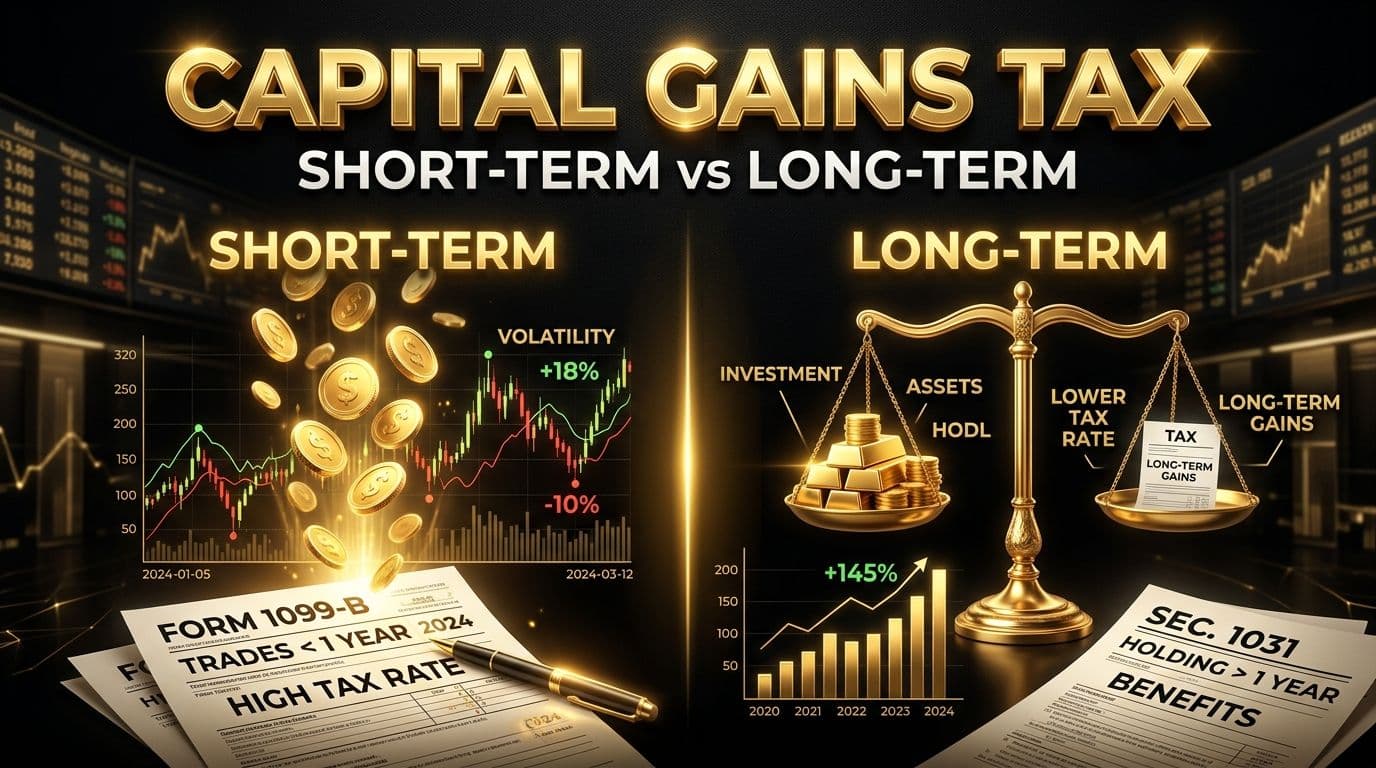
Short-term capital gains apply to assets held for one year or less before you sell them. The IRS doesn't give these gains any special treatment — they're simply added to your ordinary income and taxed at your regular federal income tax rate, which ranges from 10% to 37% depending on your total taxable income.
That means if you're in the 32% ordinary income bracket and you flip a stock after eight months, your profit is taxed at 32% — the same rate as your salary. This is the single biggest reason day traders and short-term flippers often owe far more tax than long-term investors on the exact same dollar amount of profit.
Long-Term Capital Gains Tax Explained
Long-term capital gains apply to assets held for more than one year. These gains get preferential tax treatment through a separate rate schedule: 0%, 15%, or 20%, depending on your taxable income and filing status.
For the 2026 tax year, the long-term capital gains brackets are:
- 0% rate — taxable income up to $49,450 (single) or $98,900 (married filing jointly)
- 15% rate — taxable income from $49,451 to $545,500 (single) or $98,901 to $613,700 (married filing jointly)
- 20% rate — taxable income above those thresholds
Most investors fall into the 15% bracket. That's a massive difference compared to short-term rates — an investor in the 37% ordinary bracket who sells after 13 months instead of 11 could pay 20% instead of 37% on the same gain, just by waiting two extra months.
One important detail: long-term capital gains "stack" on top of your other taxable income rather than being calculated in isolation. Your wages and ordinary income fill the lower brackets first, and your capital gains sit on top of that stack — which is why two people with identical gains can end up paying different rates if their other income differs.
Short-Term vs Long-Term Capital Gains Tax: Key Differences at a Glance
Holding period — Short-Term Capital Gains: One year or less. Long-Term Capital Gains: More than one year.
Tax rate — Short-Term Capital Gains: Ordinary income rates (10%–37%). Long-Term Capital Gains: Preferential rates (0%, 15%, 20%).
Treated as — Short-Term Capital Gains: Regular income. Long-Term Capital Gains: Separate, favorable schedule.
Best for — Short-Term Capital Gains: N/A — no tax advantage. Long-Term Capital Gains: Investors who hold long-term.
Reporting form — Short-Term Capital Gains: Schedule D + Form 8949. Long-Term Capital Gains: Schedule D + Form 8949.
The 12-Month Holding Period Rule
The line between short-term and long-term isn't fuzzy — it's exactly one year, measured from the day after you acquired the asset to the day you sold it. Hold for 365 days or less, and it's short-term. Cross into day 366, and every dollar of that gain qualifies for long-term rates instead.
This single-day difference is why many financial advisors recommend simply waiting a few extra weeks before selling an appreciated asset, if you're close to the one-year mark and there's no urgent reason to sell sooner.
Net Investment Income Tax (NIIT): The Extra Layer High Earners Should Know
Beyond the standard capital gains rates, high-income investors may also owe the Net Investment Income Tax — an additional 3.8% federal surtax on investment income, including capital gains, dividends, interest, and rental income. This applies once your modified adjusted gross income exceeds $200,000 (single) or $250,000 (married filing jointly). Unlike the capital gains brackets, these NIIT thresholds are fixed by statute and don't adjust for inflation, so more taxpayers cross them each year as incomes rise. Stacked together, a gain taxed at the 20% long-term rate can effectively cost 23.8% once NIIT applies.
Capital Gains Tax on Stocks, Real Estate, and Crypto
The short-term vs long-term rule applies the same way across most asset types, but a few categories have extra wrinkles worth knowing:
Stocks and mutual funds — Standard short-term/long-term rules apply. Mutual funds can also distribute capital gains to you at year-end even if you didn't personally sell any shares, which can create a surprise tax bill.
Real estate — If you sell an investment or rental property, gains follow the same short-term/long-term structure, but depreciation recapture can apply on top, taxing part of your gain at a separate rate of up to 25%. If you sell your primary residence, you may qualify for a home sale exclusion that shields a large portion of the gain from tax entirely, provided you meet ownership and use requirements.
Cryptocurrency — The IRS treats crypto as property, not currency, so every sale, swap, or crypto-to-crypto trade is a taxable event subject to the same short-term/long-term holding period rules as stocks.
How to Reduce Capital Gains Tax Legally
There's no way to avoid capital gains tax entirely if you have a real profit, but several legitimate strategies can lower what you owe:
- Hold for more than one year whenever possible, to qualify for the lower long-term rates instead of ordinary income rates
- Use tax-loss harvesting — selling underperforming investments to realize losses that offset your gains, reducing your overall taxable amount
- Watch the wash sale rule — you can't claim a loss if you buy a substantially identical investment within 30 days before or after the sale
- Time your sale around income dips — selling in a lower-income year can push your gain into the 0% or 15% bracket instead of 20%
- Consider a 1031 exchange for investment real estate, which allows you to defer capital gains tax by rolling proceeds into a similar property
- Use the primary residence exclusion if you're selling a home you've lived in for at least two of the last five years
- Carry forward unused losses — if your capital losses exceed your gains in a given year, you can carry the excess forward to offset future gains
Why This Matters for US LLC Owners and Non-Resident Investors
If you're a non-resident running a US LLC — for example, selling on Amazon or Shopify, or holding US investments from Pakistan — capital gains reporting adds another layer to your existing federal tax obligations. Your gains still fall under the same short-term/long-term framework, but how they're reported depends on your LLC's structure and your federal tax ID setup.
This is where getting your EIN and ITIN right matters. Many non-resident founders don't realize these serve different purposes for federal filing, which is one of the more common mistakes Pakistani US LLC owners make. Our guide on EIN vs ITIN for a US LLC breaks down exactly which one you need and when, and our ITIN guide for non-US residents walks through the application process. If you're an e-commerce seller, our post on what an ITIN means for Amazon and Shopify sellers is worth reading too.
If you haven't set up your LLC yet, capital gains and general tax exposure both depend heavily on which state you register in, so it's worth reviewing our breakdown of US LLC costs from Pakistan in 2026 and the full process to register a US LLC from Pakistan before you file anything. And regardless of your investment income, non-resident-owned LLCs still carry separate federal filing duties — BOI reporting and Form 5472 — that exist independently of your capital gains return, covered in our guide to LLC compliance, BOI, and Form 5472.
Common Mistakes People Make
- Selling an asset one day before the one-year mark, turning a long-term gain into a much more expensive short-term one
- Forgetting that short-term gains stack directly on top of ordinary income, potentially pushing you into a higher overall bracket
- Assuming all states tax capital gains the same way federally — many states tax gains as regular income, and rates vary widely
- Not tracking cost basis accurately, especially with reinvested dividends or stock splits, leading to overpaying tax
- Ignoring the wash sale rule when tax-loss harvesting, which can disqualify the loss entirely
- Overlooking the Net Investment Income Tax at higher income levels
FAQs
What is the difference between short-term and long-term capital gains tax? Short-term capital gains apply to assets held one year or less and are taxed as ordinary income (10%–37%). Long-term capital gains apply to assets held more than one year and are taxed at reduced rates of 0%, 15%, or 20%.
How long do I need to hold an asset for long-term capital gains? More than one year. Holding for exactly 365 days or less still counts as short-term; you need to cross into day 366 to qualify for long-term rates.
What is the long-term capital gains tax rate for 2026? For 2026, long-term capital gains are taxed at 0%, 15%, or 20%, depending on taxable income and filing status, with most investors falling into the 15% bracket.
Can capital losses offset capital gains? Yes. Capital losses can offset capital gains dollar-for-dollar, and if losses exceed gains, up to $3,000 of the excess can offset ordinary income each year, with the remainder carried forward to future years.
Do I owe capital gains tax on my primary home sale? Often not, or only partially. If you've owned and lived in the home for at least two of the last five years, you may qualify for an exclusion that shields a significant portion of the gain from tax.
Is capital gains tax the same as income tax? Not exactly. Short-term capital gains are taxed at the same rates as ordinary income, but long-term capital gains use a separate, generally lower rate schedule.
Final Thoughts
The difference between short-term and long-term capital gains tax comes down to one number: 365 days. Cross that line, and your tax rate can drop dramatically. Understanding this holding period rule — and planning your sales around it — is one of the simplest, most legal ways to keep more of your investment profit.
If you're managing US investment income or LLC-related capital gains from outside the country, getting your federal filings and tax ID setup right from the start prevents costly surprises later. Explore our full range of services for US company formation and compliance support, or get in touch with our team to make sure your capital gains and overall tax setup is handled correctly.
For official, up-to-date thresholds, always verify current figures directly on IRS.gov, since capital gains brackets are adjusted annually for inflation.