
Every tax season, thousands of otherwise careful filers get hit with an IRS penalty over something small — a mismatched 1099, a missed deadline, a rounding error that snowballs into a notice in the mail. Most of these mistakes are completely avoidable once you know what the IRS is actually watching for.
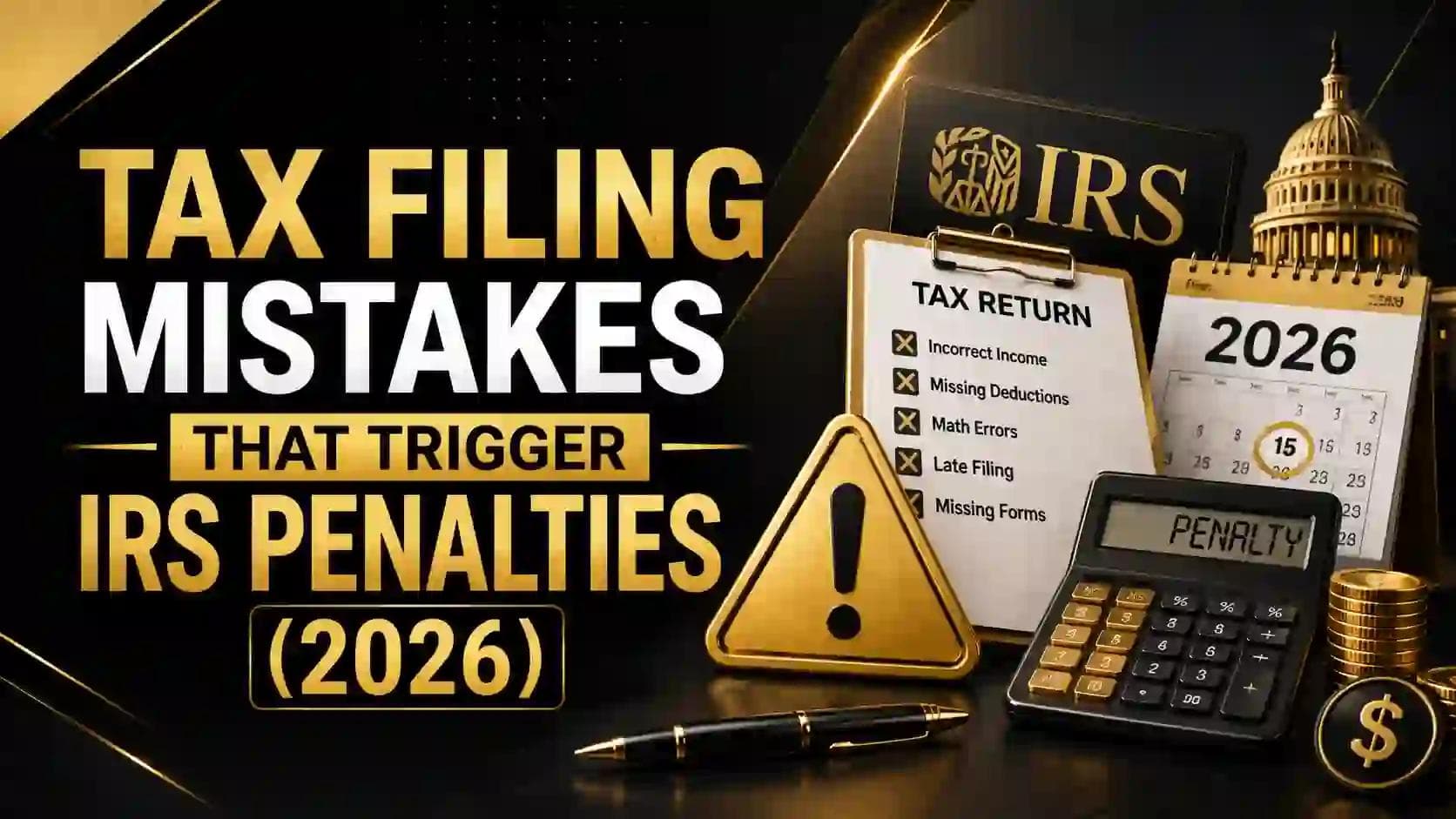
The most common tax filing mistakes that trigger IRS penalties are missing the filing deadline, underpaying estimated taxes, reporting income that doesn't match 1099/W-2 records, math errors, and claiming deductions without proper documentation. Penalties range from a percentage of unpaid tax per month to accuracy-related penalties of 20% on underreported amounts.
This guide breaks down exactly which mistakes trigger penalties, how much those penalties cost, and what to do if you've already made one.
1. Missing the Tax Filing Deadline
What triggers it: Filing your return after the deadline without an approved extension.
The penalty: Failure-to-file penalty is typically 5% of unpaid tax per month, up to 25%. This is separate from and much steeper than the failure-to-pay penalty.
How to avoid it: File Form 4868 for an automatic extension if you can't complete your return in time. Note that an extension gives you more time to file, not more time to pay. Our guide on Form 4868 and the 2026 tax extension process walks through exactly how this works.
2. Underpaying Estimated Taxes
What triggers it: Self-employed individuals and freelancers who don't pay enough tax throughout the year via quarterly estimates.
The penalty: The IRS charges an underpayment penalty calculated on the shortfall, based on current interest rates, applied for each quarter the payment was short.
How to avoid it: Pay at least 90% of your current year's tax liability or 100% of last year's liability (110% if your income is high) through estimated payments. This is one of the most common mistakes we cover in our guide on self-employment tax explained, especially for new freelancers transitioning from W-2 work.
3. Income That Doesn't Match 1099s or W-2s
What triggers it: Reporting income on your return that doesn't match what employers or clients reported to the IRS via 1099-NEC or W-2 forms.
The penalty: This typically triggers an IRS CP2000 notice, proposing additional tax owed, plus interest and potentially an accuracy-related penalty of 20% if the discrepancy is significant.
How to avoid it: Cross-check every 1099 and W-2 you receive against your reported income before filing. If you work with multiple clients or platforms, keep a running log throughout the year rather than reconstructing income at tax time.
4. Math Errors and Data Entry Mistakes
What triggers it: Simple errors — incorrect Social Security numbers, transposed numbers, miscalculated totals — that don't match IRS records.
The penalty: Math errors usually don't carry a direct penalty on their own, but they delay processing, can reduce your refund, and may trigger a formal notice requiring a response within a set window.
How to avoid it: E-file instead of paper filing — tax software automatically catches most math errors before submission. This is one reason our guide on CPA vs tax software recommends software at minimum for basic returns, even if you also use a preparer for complex situations.
5. Claiming Deductions Without Documentation
What triggers it: Claiming business expenses, home office deductions, or charitable contributions without receipts or records to back them up if audited.
The penalty: If the IRS disallows the deduction during an audit, you owe the additional tax plus interest, and potentially a 20% accuracy-related penalty if the claim was deemed unreasonable.
How to avoid it: Keep documentation for every deduction claimed — receipts, mileage logs, bank statements — for at least three years, since that's the standard IRS audit window.
6. Filing Status Errors
What triggers it: Choosing the wrong filing status (Single vs. Head of Household, or Married Filing Jointly vs. Separately) based on your actual circumstances.
The penalty: This can result in owing back taxes plus interest if the IRS determines you filed under an incorrect status that lowered your tax liability improperly.
How to avoid it: Understand exactly which status applies to your situation. Our comparison of single vs. married filing jointly breaks down which status typically results in a lower tax bill for different household situations.
7. Incorrectly Claiming Dependents
What triggers it: Claiming a dependent who doesn't meet IRS qualifying criteria, or two taxpayers claiming the same dependent.
The penalty: The IRS will disallow the claim, adjust your refund or balance owed accordingly, and may flag your return for review in future years.
How to avoid it: Confirm the dependent meets all IRS tests (relationship, residency, support, and income limits) before filing, and coordinate with any co-parent or family member who might also claim the same dependent.
8. Late Payment Even After Filing On Time
What triggers it: Filing your return by the deadline but not paying the full amount owed.
The penalty: Failure-to-pay penalty is 0.5% of unpaid tax per month, plus interest, continuing to accrue until the balance is paid in full.
How to avoid it: Even if you can't pay in full, file on time and pay what you can — the failure-to-file penalty is significantly steeper than the failure-to-pay penalty, so filing on time limits your exposure. If you're facing a missed payment situation already, our guide on what happens if you miss the tax deadline explains the next steps.
9. Self-Employment Tax Miscalculations
What triggers it: Freelancers and contractors incorrectly calculating or underpaying self-employment tax on net earnings.
The penalty: Underpayment penalties apply similarly to estimated tax shortfalls, plus interest on the unpaid balance.
How to avoid it: Use Schedule SE correctly and understand that self-employment tax applies to 92.35% of net earnings, not the full amount. Our breakdown of 1099 vs W-2 taxes covers exactly how this calculation works with a worked example.
Common IRS Penalty Amounts at a Glance
| Mistake | Penalty Type | Typical Rate |
|---|---|---|
| Filing late | Failure-to-file | 5% of unpaid tax per month, up to 25% |
| Paying late | Failure-to-pay | 0.5% of unpaid tax per month |
| Underpaying estimated tax | Underpayment penalty | Based on current IRS interest rate |
| Significant underreporting | Accuracy-related penalty | 20% of underpaid amount |
| Unfiled return after IRS notice | Combined penalties | Failure-to-file + failure-to-pay, both accruing |
What Happens If the IRS Finds a Mistake on Your Return?
- You'll typically receive a written notice (such as a CP2000) explaining the discrepancy
- The notice outlines the proposed change and any additional tax, penalty, or interest owed
- You have a set window to respond, agree, or dispute the notice
- If you agree, you pay the balance; if you disagree, you can provide documentation to contest it
Ignoring an IRS notice is one of the worst responses — unaddressed notices often escalate penalties and interest rather than resolving the issue.
Can IRS Penalties Be Waived or Reduced?
Yes, in many cases. The IRS offers penalty abatement for taxpayers who qualify:
- First-Time Penalty Abatement — available if you have a clean compliance history for the prior three years
- Reasonable Cause Relief — available if you can demonstrate circumstances beyond your control (serious illness, natural disaster, etc.)
- Statutory Exception — applies in specific situations outlined by the IRS
Requesting abatement typically requires a written request or a call to the IRS explaining your situation, along with supporting documentation.
What Triggers an IRS Audit?
- Income significantly higher or lower than similar filers in your bracket
- Large deductions relative to reported income
- Repeated business losses reported on Schedule C
- Unreported income that doesn't match third-party filings (1099s, W-2s)
- Round numbers throughout a return, which can suggest estimates rather than exact figures
- Claiming 100% business use of a vehicle or home office
Most individual returns are never audited, but certain patterns increase the statistical likelihood of review.
Expert Guidance
- File on time even if you can't pay in full — the failure-to-file penalty is far more expensive than the failure-to-pay penalty
- Reconcile every 1099 and W-2 against your records before submitting your return, not after
- Keep documentation for deductions as you go throughout the year, not scrambled together at tax time
- If you receive an IRS notice, respond within the given deadline — silence typically makes penalties worse, not better
- If this is your first penalty and you've had a clean filing history, request first-time penalty abatement before assuming you have to pay in full
Key Facts
- Failure-to-file penalties can reach up to 25% of unpaid tax
- Failure-to-pay penalties accrue at 0.5% per month, separate from failure-to-file
- Accuracy-related penalties can add 20% for significant underreporting
- First-time penalty abatement is available for taxpayers with a clean three-year compliance history
- Most IRS penalty notices arrive by mail — the IRS does not initiate contact by email or phone for penalty notices
- The IRS's official guidance on penalties and interest outlines current rates and abatement eligibility
Frequently Asked Questions
What are the most common tax filing mistakes? Missing the filing deadline, underpaying estimated taxes, income mismatches with 1099/W-2 forms, math errors, and undocumented deductions are the most common triggers for IRS penalties.
What happens if I make a mistake on my tax return? Depending on the error, the IRS may send a notice proposing a correction, adjust your refund, or in cases of significant underreporting, apply an accuracy-related penalty.
How much is the IRS penalty for filing late? The failure-to-file penalty is typically 5% of unpaid tax per month, up to a maximum of 25%.
Can I fix a mistake after filing my taxes? Yes. You can file an amended return using Form 1040-X to correct errors after your original return has been processed.
What triggers an IRS audit? Common triggers include income mismatches, unusually large deductions, repeated business losses, and unreported income compared to third-party filings.
Does the IRS charge interest on penalties? Yes. Interest accrues on both unpaid tax and unpaid penalties until the full balance is resolved.
Can IRS penalties be waived or reduced? Yes, through first-time penalty abatement or reasonable cause relief, if you meet the IRS's eligibility criteria.
Conclusion
Most IRS penalties aren't the result of dishonesty — they come from small, avoidable mistakes: a missed deadline, a mismatched 1099, a deduction claimed without a receipt to back it up. The good news is that nearly every mistake on this list has a straightforward fix, and even after a penalty hits, you often have options to reduce or remove it entirely.
Worried about a mistake on a return you've already filed? Book a consultation with Brandora Services and let our team help you correct it, respond to an IRS notice, or request penalty relief before it gets more expensive to fix.