
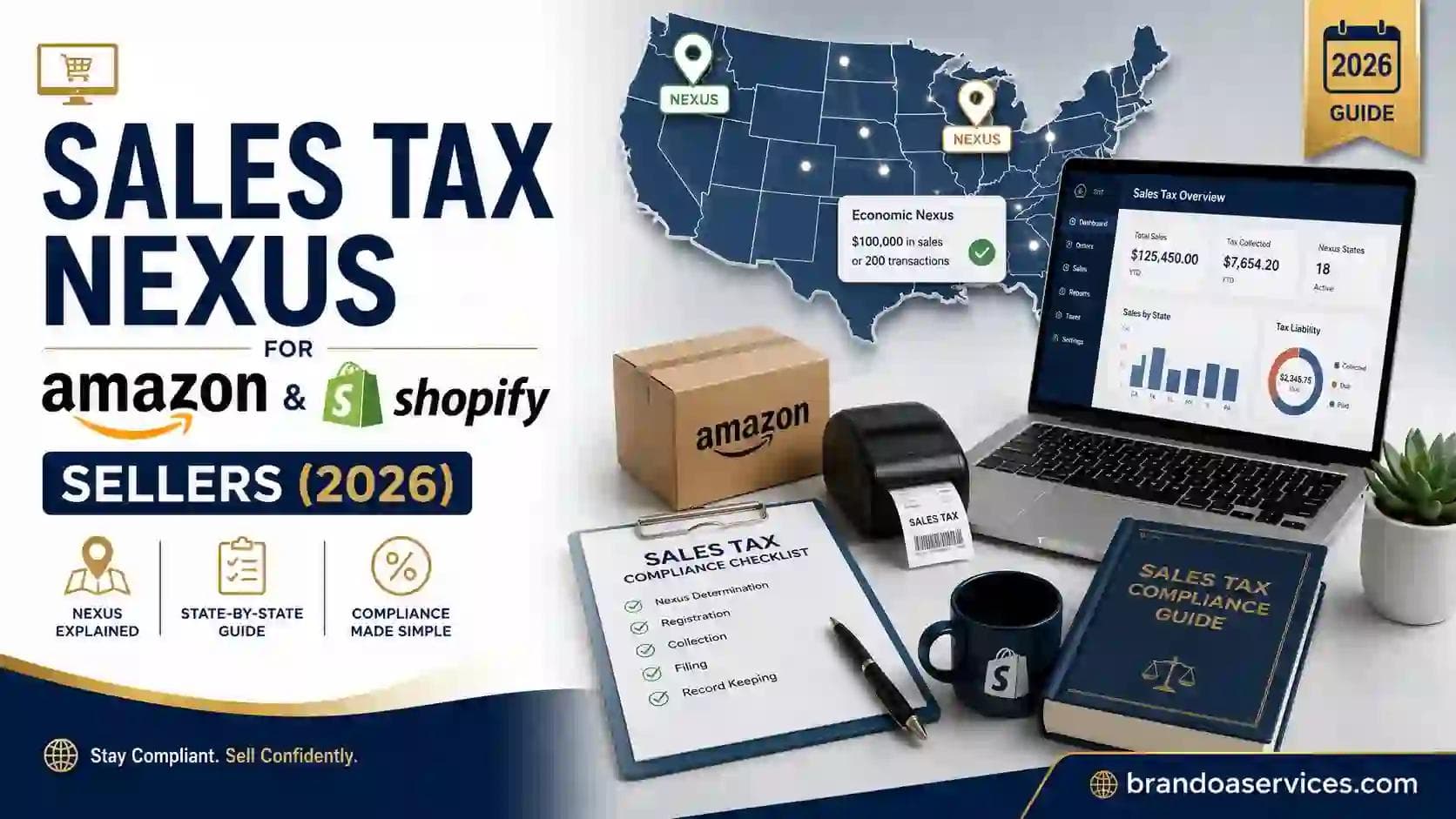
Sales tax nexus is the legal connection between your business and a state that creates an obligation to collect and remit sales tax there. If you sell on Amazon, the platform automatically collects and remits sales tax as a "marketplace facilitator" in every state that has one — which, as of 2026, is all 45 states with a general sales tax plus DC. But here's the part that catches sellers off guard: many states still require you to register and file returns once your sales cross that state's economic nexus threshold, even when Amazon is already collecting 100% of the tax. If you also sell on Shopify, those direct sales aren't covered by Amazon's collection at all — you're responsible for that tax yourself.
Disclaimer: This article is for general educational purposes only and isn't personalized tax or legal advice. Sales tax nexus rules vary significantly by state and change frequently — consult a CPA or sales tax specialist before making registration decisions.
The #1 Myth: "Amazon Collects My Tax, So I'm Covered"
This is the single biggest misconception among multi-channel sellers, and it's worth clearing up before anything else.
Marketplace facilitator laws require platforms like Amazon to calculate, collect, and remit sales tax on orders placed through that platform. That part genuinely is handled for you. But registration and collection are two separate obligations in many states. Even when Amazon collects the tax on your behalf, several states still require you to:
- Register for a sales tax permit once you cross that state's economic nexus threshold
- File periodic returns — sometimes "zero-dollar" or informational returns — reporting the marketplace-collected sales
- Separately handle any Shopify, wholesale, or direct-to-consumer sales that Amazon never touches
So a seller can cross a state's threshold purely on Amazon volume, technically owe a registration in that state, and never realize it because Amazon quietly handled the actual tax collection the whole time. If you sell through both a marketplace and your own store, you have to look at the combined picture — you cannot manage nexus you cannot see.
What Is Sales Tax Nexus, Exactly?
Sales tax nexus is the connection between your business and a state that's strong enough to create a tax obligation. There are two main types, and understanding the difference is the foundation for everything else in this guide.
Economic Nexus Trigger: Sales revenue (and sometimes transaction count) into a state crossing a threshold Applies Regardless of Sales Volume?: No — threshold-based
Physical Nexus Trigger: Inventory, employees, offices, or other physical presence in a state Applies Regardless of Sales Volume?: Yes — even one unit of inventory can trigger it
Economic nexus became the dominant standard after the landmark 2018 Supreme Court case South Dakota v. Wayfair, Inc., which allowed states to require out-of-state sellers to collect sales tax based purely on economic activity, without any physical presence required. Before Wayfair, physical presence was the only trigger — Wayfair changed the game for every remote seller, including ecommerce businesses.
Economic Nexus Thresholds in 2026
As of 2026, most states use a $100,000 in sales threshold to trigger economic nexus, measured over the current or prior calendar year. A smaller number of states set higher bars:
$100,000 Number of States (approx.): Majority of states Examples: Illinois, Florida, Colorado, Alabama
$250,000 Number of States (approx.): A few states Examples: Varies by year
$500,000 Number of States (approx.): A handful of high-volume states Examples: Texas, California, New York
Important trend for 2026: states are increasingly simplifying their rules by dropping the dual-threshold system (revenue and transaction count) in favor of revenue-only triggers. Illinois, for example, eliminated its 200-transaction threshold effective January 1, 2026 — now it's purely about the $100,000 revenue figure. Always check a state's current rule directly, since these thresholds and structures do shift from year to year.
A detail many sellers miss: in some states, exempt sales still count toward your threshold calculation, even though they wouldn't be taxed themselves. A business could hit economic nexus in a state through a mix of taxable and exempt sales without realizing it.
FBA Inventory Nexus: The Trigger That Has Nothing to Do With Sales Volume
This is where Amazon FBA sellers face a genuinely different risk than typical ecommerce sellers.
When Amazon stores your inventory in a fulfillment center, that inventory can establish physical nexus in that state — regardless of how much (or how little) you've sold there. Even a single pallet sitting in a warehouse can be enough. This is a stronger and legally older standard than economic nexus, and the economic threshold protections simply don't apply to it.
The tricky part: you often don't choose which warehouses your inventory ends up in. Amazon's fulfillment network moves stock to optimize logistics across its own system, which means your nexus footprint can expand without any deliberate decision on your part. This is commonly called "FBA nexus," and it's one of the most misunderstood aspects of selling on the platform.
Practical takeaway: if you're an FBA seller, you need to periodically check your Inventory Event Detail Report (available in Seller Central) to see exactly which states are currently holding your stock — this is the starting point for understanding your real nexus footprint, separate from your revenue-based economic nexus.
If you're deciding where to base your business structure with FBA operations in mind, our guide on the best state to form an LLC for Amazon FBA sellers covers a related decision that often comes up alongside nexus planning.
Marketplace Facilitator Laws: What They Do and Don't Cover
Every US state with a general sales tax, plus DC, now has a marketplace facilitator law on the books (Missouri was the last to adopt one). Here's exactly what that means in practice:
What marketplace facilitator laws DO cover:
- Amazon calculates, collects, and remits sales tax on orders placed through Amazon's marketplace
- This applies to third-party FBA and merchant-fulfilled orders processed through Amazon's checkout
What they DON'T cover:
- Your own Shopify store, website, or any direct-to-consumer sales channel
- Wholesale transactions handled outside the marketplace
- Your state registration and filing obligations, which in many states remain separate from collection
- Income, franchise, or gross-receipts tax obligations tied to FBA inventory — marketplace laws only touch sales tax, not other state-level business taxes
This last point trips up a lot of sellers: even in states where Amazon handles 100% of sales tax collection, having FBA inventory stored there can still create an obligation to register for state income or franchise tax, entirely separate from the sales tax question.
Amazon vs Shopify: Where Your Responsibilities Actually Differ
Factor
Amazon (FBA/Marketplace)
Shopify (Direct Sales)
Tax collection at checkout
Handled automatically by Amazon in facilitator states
You must configure and collect it yourself
Physical nexus risk
High — inventory location-driven, often outside your control
Low — typically only where you have offices/warehouses
Economic nexus counts toward threshold
Yes, in most states
Yes, and combines with Amazon sales toward the same state threshold
Registration/filing obligation
May still apply even with collection handled
Always applies once nexus is triggered
The critical point for multi-channel sellers: your Amazon sales and Shopify sales typically combine toward the same state's economic nexus threshold, even though only one channel is collecting tax automatically. A seller doing $70,000 on Amazon and $40,000 on Shopify into the same state has likely crossed a $100,000 threshold — and the Shopify portion of that revenue is entirely the seller's responsibility to collect and remit.
For guidance on choosing between structuring your ecommerce business as an LLC in different jurisdictions as you scale across channels, see our comparison of LLC vs. Ltd for ecommerce businesses.
Do I Need a Sales Tax Permit in Every State I Sell In?
No — only in states where you've established nexus, either economic (crossing the revenue/transaction threshold) or physical (inventory, employees, or other presence). Registering in a state before you have nexus there isn't necessary and can create unnecessary filing obligations.
The practical process once you do have nexus:
- Register for a sales tax permit with that state's Department of Revenue
- Determine your filing frequency (monthly, quarterly, or annually, based on sales volume)
- File returns on schedule, even if the return reports $0 owed because Amazon already collected everything
- Keep records of both marketplace-collected and directly-collected sales separately, since many state returns require this breakdown
What Happens If You've Been Ignoring Nexus?
If you discover you've had unregistered nexus in a state for a while, the IRS-equivalent process at the state level is typically a Voluntary Disclosure Agreement (VDA). A VDA allows a business to come forward proactively, often limiting the lookback period (commonly to 3–4 years instead of the full history) and reducing or eliminating penalties, in exchange for registering and paying back taxes owed.
This is generally a far better outcome than waiting for a state to identify the gap independently, since penalties and lookback periods tend to be more severe once a state initiates contact first. If you're catching up on other tax obligations at the same time, our guide on what happens when you miss a tax deadline covers the broader principles that apply here as well.
Setting Up Sales Tax Correctly on Shopify
Unlike Amazon, Shopify does not automatically calculate and remit sales tax for you by default — you need to configure tax collection yourself once you've determined where you have nexus. This generally involves:
- Identifying every state where you have economic or physical nexus
- Registering for a sales tax permit in each of those states
- Configuring Shopify's tax settings to collect the correct rate for each nexus state (Shopify can calculate rates automatically once told where to collect, but it won't decide where for you)
- Filing and remitting collected tax on each state's required schedule
Given how many moving parts are involved — multiple states, different filing frequencies, and the need to track FBA inventory movement separately from Shopify sales — many growing sellers eventually move to dedicated sales tax automation software rather than tracking this manually.
Sales Tax ID Requirements for Amazon and Shopify Sellers
Whether you need a sales tax ID (separate from your federal EIN) depends on whether you've triggered nexus, not simply on whether you're selling. If you're a non-US resident or new seller trying to understand which tax identifiers actually apply to your situation, our breakdown of what an ITIN is for Amazon and Shopify sellers is a useful companion resource, since sellers often confuse federal tax ID requirements with state sales tax registration — they're governed by entirely different rules.
Frequently Asked Questions
What is sales tax nexus? Sales tax nexus is the legal connection between a business and a state strong enough to create an obligation to collect and remit sales tax there, established either through economic activity (a sales threshold) or physical presence (inventory, employees, etc.).
Does Amazon collect and remit sales tax for me? Yes, for orders placed through Amazon's marketplace, in every state with a marketplace facilitator law — which is currently all 45 states with a general sales tax plus DC.
Do I still need to register for sales tax if a marketplace collects it? Often, yes. Many states require sellers to register and file returns — sometimes zero-dollar returns — once they cross that state's economic nexus threshold, even when Amazon already collects 100% of the tax.
What is the difference between economic nexus and physical nexus? Economic nexus is triggered by sales revenue (and sometimes transaction count) crossing a state threshold. Physical nexus is triggered by a physical presence like inventory or employees, and applies regardless of sales volume.
Does storing inventory in an Amazon warehouse create nexus? Yes. FBA inventory storage generally creates physical nexus in that state, even with minimal sales volume, since physical presence is a stronger legal standard than the economic threshold.
What is the most common economic nexus threshold? $100,000 in sales into a state during the current or prior calendar year is the most widely used threshold, though a handful of states use $250,000 or $500,000.
Does my Shopify store need its own sales tax nexus check separate from Amazon? Yes. Shopify's direct sales aren't covered by Amazon's marketplace collection, and in most states, your Amazon and Shopify sales combine toward the same state's economic nexus threshold — so you need visibility into both channels together.
Final Thoughts: You Can't Manage Nexus You Can't See
The single most useful habit for any multi-channel ecommerce seller is tracking sales by state, across every channel, on a rolling basis — so a state you're approaching never becomes a surprise. Marketplace facilitator laws have genuinely simplified sales tax collection for Amazon orders, but they haven't eliminated the underlying complexity: registration obligations, FBA-driven physical nexus, and Shopify's uncovered direct sales all still require active monitoring.
Getting this wrong isn't just an administrative headache — unregistered nexus that goes unnoticed for years can turn into a meaningful back-tax and penalty exposure. Getting it right, on the other hand, is mostly a matter of good tracking habits and knowing which obligations marketplace collection does and doesn't cover.
For authoritative source information on the legal foundation of economic nexus, the Supreme Court's ruling in South Dakota v. Wayfair, Inc. is the original source that reshaped remote seller tax obligations nationwide.
Not sure where your Amazon and Shopify sales have created nexus? Brandora Services helps multi-channel ecommerce sellers map their nexus footprint, register correctly, and stay compliant across every state they sell in. Explore our services or get in touch for guidance tailored to your specific sales channels and inventory locations.