
If you've started freelancing, picked up a side hustle, or begun trading under your own name, there's a good chance you already owe HMRC a phone call, or rather, an online form. Registering as self-employed in the UK isn't complicated, but missing the deadline or skipping a step can cost you in penalties and delays later on.
This guide walks you through exactly how to register as self-employed with HMRC, what documents you need, when you must do it by, and what happens once you're registered. Whether you're a freelancer, a sole trader, or just testing a side project, this article covers everything in plain English, no jargon, no guesswork.
If you'd rather have a professional handle the paperwork and make sure nothing slips through the cracks, Brandora's Taxation & Accounting services can register you correctly and set up your Self Assessment from day one.
What Does It Mean to Be Self-Employed in the UK?
Being self-employed means you run your own business as an individual rather than working as someone else's employee. You're responsible for your own income, your own tax, and your own National Insurance contributions. Most self-employed people in the UK operate as sole traders, the simplest and most common business structure, where there's no legal separation between you and your business.
This is different from being a limited company director, where the business is a separate legal entity. If you're weighing up which structure suits you better long-term, it's worth exploring the difference before you register, since switching later means extra admin.
Why Registering as Self-Employed Matters
Registering isn't optional once your circumstances meet HMRC's criteria. It's how HMRC knows to expect a tax return from you, how your National Insurance record stays protected, and how you stay on the right side of the law. Trading without registering, even unintentionally, can result in penalties, back-dated tax demands, and interest charges once HMRC catches up.
Beyond compliance, registering properly also gives you legitimacy. You'll be able to provide proof of income for mortgages, loans, or visa applications, invoice clients with confidence, and claim allowable business expenses that reduce your tax bill.
Who Needs to Register as Self-Employed?
You generally need to register as self-employed with HMRC if any of the following apply:
You earned more than £1,000 from self-employment in a tax year (this is known as the trading allowance threshold)
You want to claim Tax-Free Childcare based on self-employment
You want to pay voluntary Class 2 National Insurance contributions to protect benefits like your State Pension
If your total income from self-employment is under £1,000 in a tax year, you may not need to register at all, thanks to the trading allowance. However, many people register anyway if they expect to grow past that threshold, since it avoids a scramble later.
This applies whether you're a freelance designer in Manchester, a tradesperson in Cardiff, a consultant in Edinburgh, or a delivery driver in Belfast. The registration process itself is identical across England, Scotland, Wales, and Northern Ireland, since Self Assessment is a UK-wide HMRC system.
Documents and Information You'll Need Before You Register
Before you start the registration process, have the following ready:
Your National Insurance number
A valid UK address and contact details
Your business name (if different from your own name)
The date your self-employment started
A description of what your business does
An email address for your Government Gateway account
Having these on hand means you can complete the entire registration in one sitting rather than starting and stopping halfway through.
How to Register as Self-Employed: Step-by-Step Guide
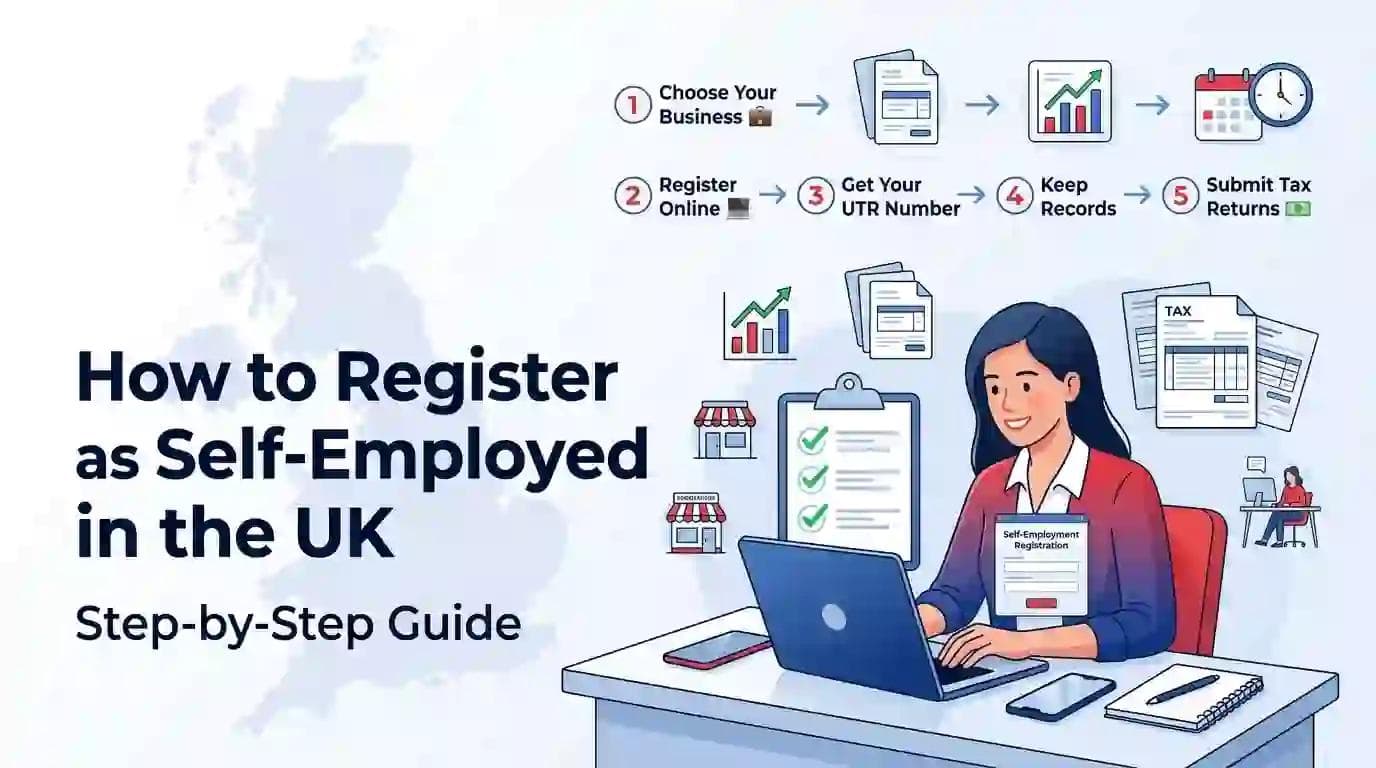
Here's the full process, broken down into simple steps.
Step 1: Confirm You Need to Register
Check whether your self-employment income for the tax year has crossed, or is likely to cross, the £1,000 trading allowance. If it has, or you want to protect your National Insurance record regardless, move on to registration.
Step 2: Create a Government Gateway Account
If you don't already have one, you'll need to set up a Government Gateway account through HMRC's online services. This becomes your login for Self Assessment, your Personal Tax Account, and future tax filings. You'll receive a Government Gateway user ID, keep this somewhere safe, since you'll need it every year.
Step 3: Complete Your Registration Online
Once your account is set up, you register for Self Assessment as a sole trader through HMRC's official online service. This is sometimes referred to as the CWF1 process, the form historically used for registering existing sole traders who are also newly self-employed. Most people now complete this entirely online rather than submitting a paper form. According to gov.uk guidance, you can register as self-employed directly through HMRC's official portal, which walks you through confirming your details and business activity.
Step 4: Receive Your Unique Taxpayer Reference (UTR)
After registering, HMRC will post you a 10-digit Unique Taxpayer Reference, your UTR number. This typically arrives within 10 working days (longer if you're based outside the UK). Your UTR is essential, you'll need it every time you file a Self Assessment tax return, so store it securely rather than relying on memory.
Step 5: Set Up Your Record-Keeping
Once registered, start keeping accurate records of your income and expenses from day one. This doesn't need to be complicated, a simple spreadsheet works fine for many small sole traders, though accounting software becomes worthwhile once your business grows. Good records make your Self Assessment far less stressful when the deadline approaches.
Step 6: File Your Self Assessment Tax Return
Each year, you'll need to file a Self Assessment tax return declaring your income and expenses, and pay any tax owed. This is separate from the registration itself but is the ongoing obligation that registration sets you up for.
Self-Employed Registration Deadline in the UK
This is the part people most often get wrong: the deadline to register as self-employed is 5 October following the end of the tax year in which you started trading.
For example, if you started trading in July 2026, the tax year runs to 5 April 2027, meaning you'd need to register by 5 October 2027. Missing this deadline can result in a "failure to notify" penalty from HMRC, even if you go on to pay your tax in full and on time.
It's a good habit to register as soon as you start trading rather than waiting until the deadline approaches, since it removes the risk of forgetting altogether.
What Happens After You Register?
Once registration is complete and you've received your UTR, HMRC will expect a Self Assessment tax return from you each year, even in years where your income was low or you made a loss. You'll typically need to:
File your return online by 31 January following the end of the tax year
Pay any tax owed by the same 31 January deadline
Make "payments on account" toward the following year's tax bill, if applicable
Keep records for at least five years after the submission deadline
If your circumstances change, for instance, you stop trading, or your business grows enough that incorporating as a limited company makes more sense, you'll need to update HMRC accordingly.
Self-Employed Tax and National Insurance Explained
Understanding what you'll actually pay is just as important as registering correctly.
Income Tax Self-employed profits are taxed the same way as employment income, through Income Tax bands. You get a tax-free Personal Allowance, and profits above that are taxed at the basic, higher, or additional rate depending on how much you earn.
National Insurance Self-employed people pay Class 4 National Insurance as a percentage of their profits above a certain threshold. Class 2 National Insurance, once a flat weekly payment, was abolished in April 2024. If your profits are above the Small Profits Threshold, your National Insurance record is protected automatically, without a separate payment.
Allowable Expenses You can deduct legitimate business expenses, things like equipment, travel, and a portion of home utility costs if you work from home, before calculating your taxable profit. Keeping receipts and records throughout the year makes this significantly easier at tax time.
Sole Trader vs Limited Company: Which Should You Choose First?
Most people register as a sole trader initially because it's fast, free, and requires minimal admin. A limited company involves registering with Companies House, ongoing filing obligations, and a more complex tax structure involving Corporation Tax, salary, and dividends.
There's no universally "better" answer, it depends on your income level, your appetite for admin, and whether liability protection matters to you. Many freelancers and small business owners stay sole traders for years before incorporating once their profits justify it. If you do eventually incorporate, staying compliant afterwards means understanding your ongoing filing duties, our Companies House compliance checklist breaks down exactly what's required once you've made that switch.
Common Mistakes to Avoid When Registering as Self-Employed
A few avoidable errors come up again and again:
Registering late and missing the 5 October deadline, triggering an unnecessary penalty
Losing your UTR number and having to request it again, which delays your first tax return
Assuming you don't need to register because you're "just doing it part-time," when your income has already crossed the trading allowance
Mixing personal and business finances from the start, making it harder to track profit accurately
Forgetting to register for VAT once turnover crosses the VAT threshold, a separate registration from Self Assessment
Avoiding these mistakes early saves considerable stress when your first tax return comes around.
Registering as Self-Employed From Outside the UK
If you're a non-UK resident earning self-employment income connected to the UK, or planning to relocate and start trading here, the registration principles are broadly similar, though additional considerations around residency status and tax treaties may apply. If you're weighing up registering a UK business structure from abroad rather than as an individual sole trader, our guide on how non-UK residents can register a company in the UK covers the process in detail.
Why Choose Brandora Services
Registering as self-employed is straightforward on paper, but getting it right, on time, with accurate records from the start, is where most people either save money or lose it unnecessarily. Brandora Services' ACCA and CA-certified team handles self-employed registration, Self Assessment filing, and ongoing bookkeeping for sole traders across the UK, so you're never guessing whether you've done it correctly.
Rather than piecing together guidance from forums and outdated blog posts, working with a dedicated accounting partner means your registration, tax planning, and annual filings are handled by people who do this every day.
Real-World Example
Consider a freelance graphic designer who started taking on paid client work in June 2026. By September, her income from freelance projects had passed £1,000. Because she registered as self-employed promptly, before the 5 October 2027 deadline, she avoided any penalty, received her UTR within two weeks, and was able to start tracking her expenses (a new laptop, software subscriptions, a portion of her home internet bill) from day one. When her first Self Assessment deadline arrived the following January, she had clean records ready to go, rather than scrambling to reconstruct months of transactions from memory.
This is the practical value of registering early and correctly: it's not just about compliance, it directly reduces the stress and cost of your first tax return.
Future Opportunities for Self-Employed Professionals in the UK
The number of self-employed workers in the UK continues to be shaped by the growth of freelance platforms, remote consulting, and the broader gig economy. Once you're properly registered, the path forward is flexible: you can scale up as a sole trader indefinitely, bring on subcontractors, or eventually transition to a limited company once your profits and plans justify the added complexity. Being registered correctly from the outset means none of those future options are complicated by messy or missing paperwork.
Frequently Asked Questions
How do I register as self-employed in the UK? You register online through HMRC's Self Assessment service using a Government Gateway account. You'll need your National Insurance number, business details, and the date your self-employment started. HMRC then posts you a UTR number, usually within 10 working days.
When do I need to register as self-employed? You should register by 5 October following the end of the tax year in which you started trading. Registering as soon as you begin earning is safer than waiting, since it removes the risk of missing the deadline entirely.
Do I need to register if I earn under £1,000? Not necessarily. HMRC's trading allowance means income under £1,000 in a tax year generally doesn't require registration. Many people register anyway if they expect to exceed this threshold soon.
What is a UTR number and how do I get one? A UTR (Unique Taxpayer Reference) is a 10-digit number HMRC assigns to you after registration. It's used every time you file a Self Assessment tax return and is sent automatically by post once registration is complete.
Can I be employed and self-employed at the same time? Yes. Many people work a PAYE job while also running a self-employed side business. You'll pay tax through PAYE on your employment income and declare your self-employed profits separately through Self Assessment.
What happens if I don't register as self-employed? If HMRC determines you should have registered and didn't, you may face a "failure to notify" penalty, plus interest on any tax owed. Registering promptly avoids this entirely, even if your first year's profit is modest.
Final Thoughts
Registering as self-employed in the UK is one of those tasks that feels intimidating until you actually sit down and do it, in reality, it takes less time than most people expect. The real risk isn't the registration process itself, it's delaying it past the 5 October deadline or starting without a clear system for tracking income and expenses.
Get the registration right, keep clean records from day one, and the rest of your self-employed journey, from your first Self Assessment return to eventually deciding whether a limited company makes sense, becomes far more manageable.
Not sure where to start, or want someone to handle the registration and your first tax return for you? Brandora Services' certified accounting team can register you as self-employed, set up your records correctly, and keep you compliant year after year. Book a free consultation and get it done right from day one.