
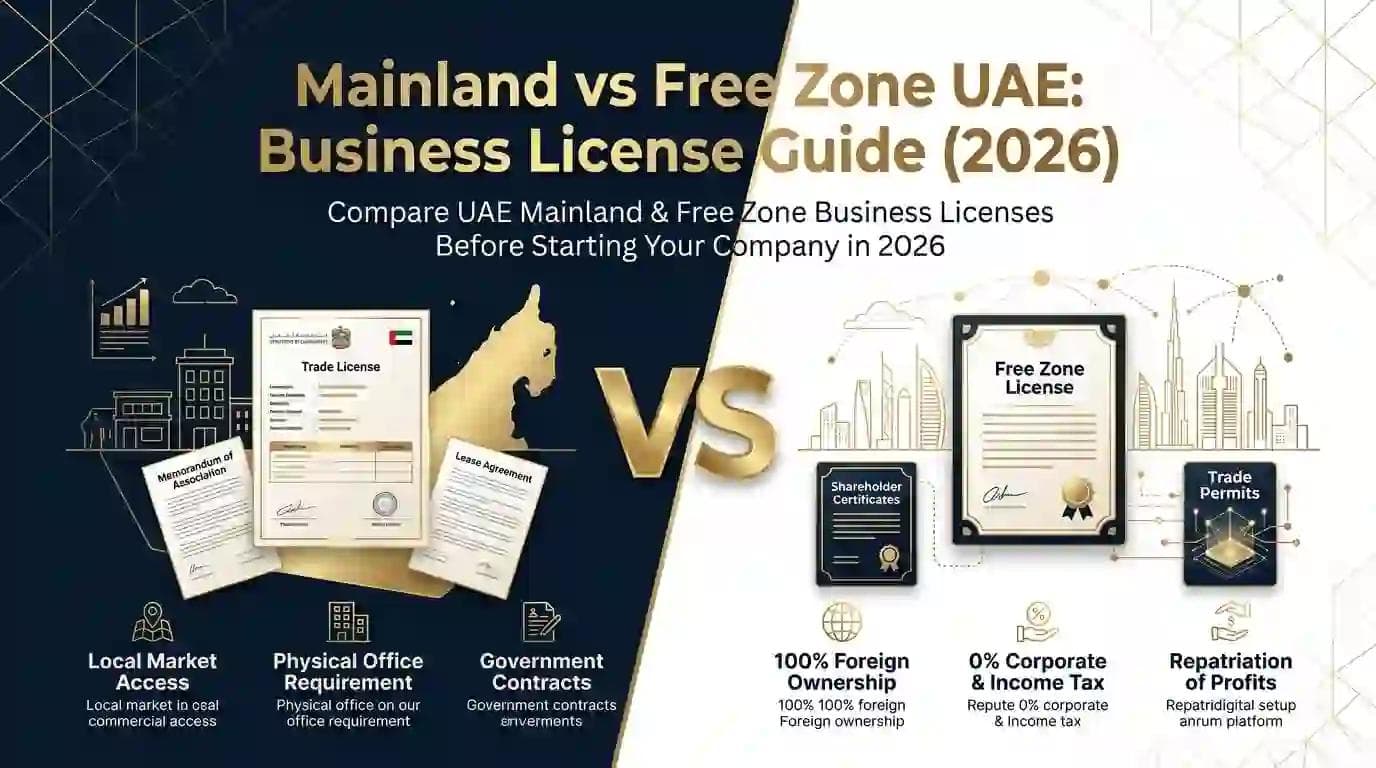
Choosing between a mainland and a free zone license is the first real decision you'll make when setting up a business in the UAE, and it shapes almost everything that follows: who can own the company, where you can sell, how much tax you'll pay, and how much the whole setup costs. In short, a mainland license lets you trade anywhere across the UAE and now comes with 100% foreign ownership for most activities, while a free zone license gives you a fast, low-cost setup with 0% corporate tax on qualifying income, but restricts you from selling directly to the UAE mainland market without extra steps.
This guide breaks down exactly how mainland and free zone licenses differ in 2026, what each actually costs, and how to figure out which one fits your business.
What Is a Mainland Business License?
A mainland license is issued by the Department of Economy and Tourism (DET), known in some emirates as the Department of Economic Development (DED). It allows your company to operate anywhere in the UAE, take on government contracts, and trade directly with customers across all seven emirates without any restriction on market access.
For years, mainland companies required a UAE national to hold a majority stake (51%) in most business activities. That changed with Federal Decree-Law No. 26 of 2020, later consolidated under Federal Decree-Law No. 32 of 2021 on Commercial Companies, which removed the mandatory local majority shareholder requirement for the vast majority of commercial and industrial activities. Today, foreign investors can own 100% of a mainland company in most sectors. A small number of strategic or security-sensitive activities still carry ownership or licensing conditions, so it's worth checking your specific activity before assuming full ownership applies automatically.
What Is a Free Zone Business License?
A free zone license is issued by one of the UAE's 50-plus Free Zone Authorities, each operating as a self-contained economic zone with its own rules, infrastructure, and industry focus. DMCC in Dubai is built around commodities and trade, DIFC around financial services, Dubai Internet City around tech, and so on.
Free zones have always offered 100% foreign ownership, so that part of the pitch hasn't changed. What has shifted is the tax picture. Free zone companies are no longer automatically tax-free. To pay 0% corporate tax, a free zone entity has to qualify and maintain status as a Qualifying Free Zone Person (QFZP) under Federal Decree-Law No. 47 of 2022, earning only "qualifying income" and meeting ongoing substance and compliance requirements. Fall out of QFZP status, even briefly, and the company becomes fully taxable at the standard rate for that entire year.
Mainland vs Free Zone: Key Differences at a Glance
Factor: Licensing authority
Mainland: DET / DED (per emirate)
Free Zone: Individual Free Zone Authority (e.g., DMCC, IFZA, JAFZA)
Factor: Foreign ownership
Mainland: Up to 100% for most activities
Free Zone: 100%, always
Factor: Market access
Mainland: Anywhere in the UAE, no restrictions
Free Zone: Free zone and international; mainland sales need a distributor, branch, or separate LLC
Factor: Corporate tax
Mainland: 9% on profits above AED 375,000
Free Zone: 0% on qualifying income if QFZP conditions are met; otherwise 9%
Factor: Office requirement
Mainland: Physical office generally required
Free Zone: Flexi-desk or co-working space often sufficient
Factor: Visa quota
Mainland: Based on office size
Free Zone: Based on license package
Factor: Setup timeline
Mainland: Typically longer, more documentation
Free Zone: Often 1 to 3 weeks
Factor: Government contracts
Mainland: Eligible
Free Zone: Generally not eligible
Mainland vs Free Zone vs Offshore: What's the Difference?
It's worth clearing up a third option that often gets lumped in with these two. An offshore company in the UAE isn't licensed to operate inside the country at all. It can't rent office space, sponsor visas, or trade with UAE customers. Offshore structures exist purely for holding assets, international trading, or tax planning outside the UAE. If you actually plan to run operations, hire staff, or serve customers from within the UAE, you're choosing between mainland and free zone, not offshore.
Do I Need a Local Sponsor for a Mainland Company?
For most commercial and industrial activities, no. Since the 2021 ownership reforms, foreign investors can hold 100% of a mainland company without a UAE national partner. That said, a limited set of activities tied to security, oil and gas, and a few other strategic sectors still require Emirati participation or specific licensing conditions. If your business falls into one of these categories, a local service agent or partner may still be part of the structure, so it's worth confirming your exact activity code with the relevant DED before assuming full ownership applies.
Do Free Zone Companies Pay Corporate Tax?
Sometimes, and this catches a lot of business owners off guard. The UAE introduced federal corporate tax for financial years starting on or after 1 June 2023, at a standard rate of 9% on taxable profits above AED 375,000, with profits below that threshold taxed at 0%.
Free zone companies can still access a 0% rate, but only on qualifying income and only if they meet the QFZP conditions on an ongoing basis, not just at setup. This typically means maintaining adequate substance in the free zone, earning income from qualifying activities, and keeping non-qualifying income under strict limits. Many smaller free zone businesses with revenue under AED 3 million instead opt for Small Business Relief, which simplifies compliance without requiring the qualifying-income segregation that QFZP demands.
Mainland companies don't have a qualifying-income concept at all. Profits above AED 375,000 are simply taxed at 9%, full stop, which makes tax planning more predictable even if the headline number is less attractive than a free zone's potential 0%.
Can a Free Zone Company Trade in Mainland UAE?
Not directly, by default. A free zone license restricts you from selling goods or services straight to mainland customers. Historically, the workaround was appointing a mainland distributor, opening a mainland branch, or forming a separate mainland LLC altogether. Onshore-access rules have loosened somewhat in recent years, allowing certain free zone entities to serve mainland customers under specific conditions without a full separate company, but this still depends heavily on your activity and free zone. If your business model depends on direct UAE-wide sales from day one, that's usually a strong signal to lean mainland rather than free zone.
How Much Does a Business License Cost in the UAE?
Costs vary widely depending on the emirate, free zone, business activity, and number of visas required, but a few patterns hold consistently in 2026:
- Free zone licenses tend to have a lower entry cost, with many packages bundling a flexi-desk, a limited number of visas, and the license fee into one price. This is a major reason free zones remain popular with startups and solo founders.
- Mainland licenses often involve a higher upfront cost once you factor in a physical office lease (a standard mainland requirement in most emirates), though the exact figure depends heavily on location and activity.
- Ongoing costs for both structures include license renewal, visa renewals, health insurance per visa holder, and corporate tax registration through EmaraTax, which is mandatory within three months of incorporation regardless of structure.
If you need visas beyond your package allocation, free zone costs can climb quickly, particularly if you need to upgrade from a flexi-desk to a dedicated office to support more visas.
Which Is Better: Mainland or Free Zone?
It depends entirely on what you're building. Here's a practical way to think about it:
Choose mainland if:
- You need to sell directly to customers across the UAE
- You want to bid on government contracts
- Your business is service-based and client-facing within the UAE (retail, restaurants, clinics, consulting to local clients)
Choose free zone if:
- Your revenue comes mainly from international clients or exports
- You want the fastest, lowest-cost setup
- You're an e-commerce, tech, trading, or consulting business without heavy reliance on mainland walk-in customers
- Tax efficiency through QFZP status is a genuine priority and you can structure income accordingly
A consulting firm serving mostly UAE-based clients will often find mainland more practical despite the 9% tax exposure, simply because it avoids the market-access restrictions. A cross-border e-commerce or SaaS business selling internationally, on the other hand, is usually better served by a free zone structure with QFZP eligibility.
If you're weighing this decision as part of a broader choice between business structures in different countries, it's worth comparing it against options like a US LLC or UK Ltd company too. Our breakdown of an LLC vs Ltd for e-commerce businesses covers how ownership, liability, and tax treatment differ across jurisdictions, which is useful context if you're deciding not just between mainland and free zone, but between the UAE and another country entirely.
Best Free Zones by Business Activity
Not all free zones serve the same purpose, and picking the right one for your activity matters as much as picking free zone over mainland in the first place:
- DMCC – strong fit for trading, commodities, and general commercial activities
- IFZA – popular for cost-conscious startups and consulting businesses
- JAFZA – built for logistics, import/export, and industrial operations near Jebel Ali Port
- Dubai Internet City / similar tech zones – suited to software, IT services, and digital businesses
- DIFC – the go-to for financial services and fintech, with its own common-law framework
How Long Does It Take to Get a UAE Business License?
Free zone setups are typically the faster route, often completed in one to three weeks once documents are submitted correctly. Mainland setups can take longer, mainly due to additional approvals depending on activity type, office lease finalization, and any external approvals required for regulated activities (such as healthcare, education, or financial services). Founders operating from outside the UAE should build in extra time for document attestation and remote onboarding processes.
Frequently Asked Questions
What is the difference between mainland and free zone in UAE? A mainland company can trade anywhere in the UAE and is licensed by the DET/DED, while a free zone company is licensed by an individual Free Zone Authority and is generally restricted to free zone and international trade unless it uses a distributor or separate mainland entity.
Is free zone or mainland better for business in UAE? Neither is universally better. Free zone suits export-focused, international, or lower-cost setups, while mainland suits businesses that need to sell directly across the UAE or bid on government contracts.
Can a free zone company operate in mainland UAE? Not directly by default. It usually needs a mainland distributor, a mainland branch, or a separate mainland LLC to sell to UAE-based customers.
Do I need a local sponsor for a mainland business in UAE? For most commercial and industrial activities, no. Foreign investors can hold 100% ownership since the 2021 reforms, though some strategic sectors still carry ownership conditions.
Do free zone companies pay corporate tax in UAE? Only if they don't meet Qualifying Free Zone Person (QFZP) conditions. Qualifying free zone companies can access 0% tax on qualifying income; otherwise, they pay the standard 9% rate above AED 375,000 in profit.
How long does UAE business license approval take? Free zone licenses are often approved within one to three weeks. Mainland licenses can take longer depending on activity type, required approvals, and office lease arrangements.
Final Thoughts
Mainland and free zone licenses aren't competing versions of the same thing, they're built for different business models. Mainland buys you unrestricted access to the UAE market and government contracts, at the cost of full 9% corporate tax exposure. Free zone buys you speed, lower setup costs, and a shot at 0% tax through QFZP status, at the cost of restricted mainland market access. The right choice comes down to where your customers actually are and how your revenue is structured, not which option sounds more prestigious.
If you're still weighing this decision, or comparing UAE setup against forming a company in the US or UK instead, Brandora Services can help you map out the ownership, tax, and compliance trade-offs before you commit. Get in touch for a setup consultation, or browse more country-by-country guides on our blog to compare your options side by side.
Ownership rules, corporate tax figures, and QFZP conditions referenced above reflect UAE regulations as of July 2026. Rules can vary by emirate, free zone, and business activity, so always confirm current requirements directly through the UAE government portal (u.ae) or the Federal Tax Authority (tax.gov.ae) before filing.